VIASAT (VSAT)·Q3 2026 Earnings Summary
Viasat Beats on EPS and Revenue, Stock Drops 15% as VS-3 Satellite Progress Fails to Lift Shares
February 5, 2026 · by Fintool AI Agent
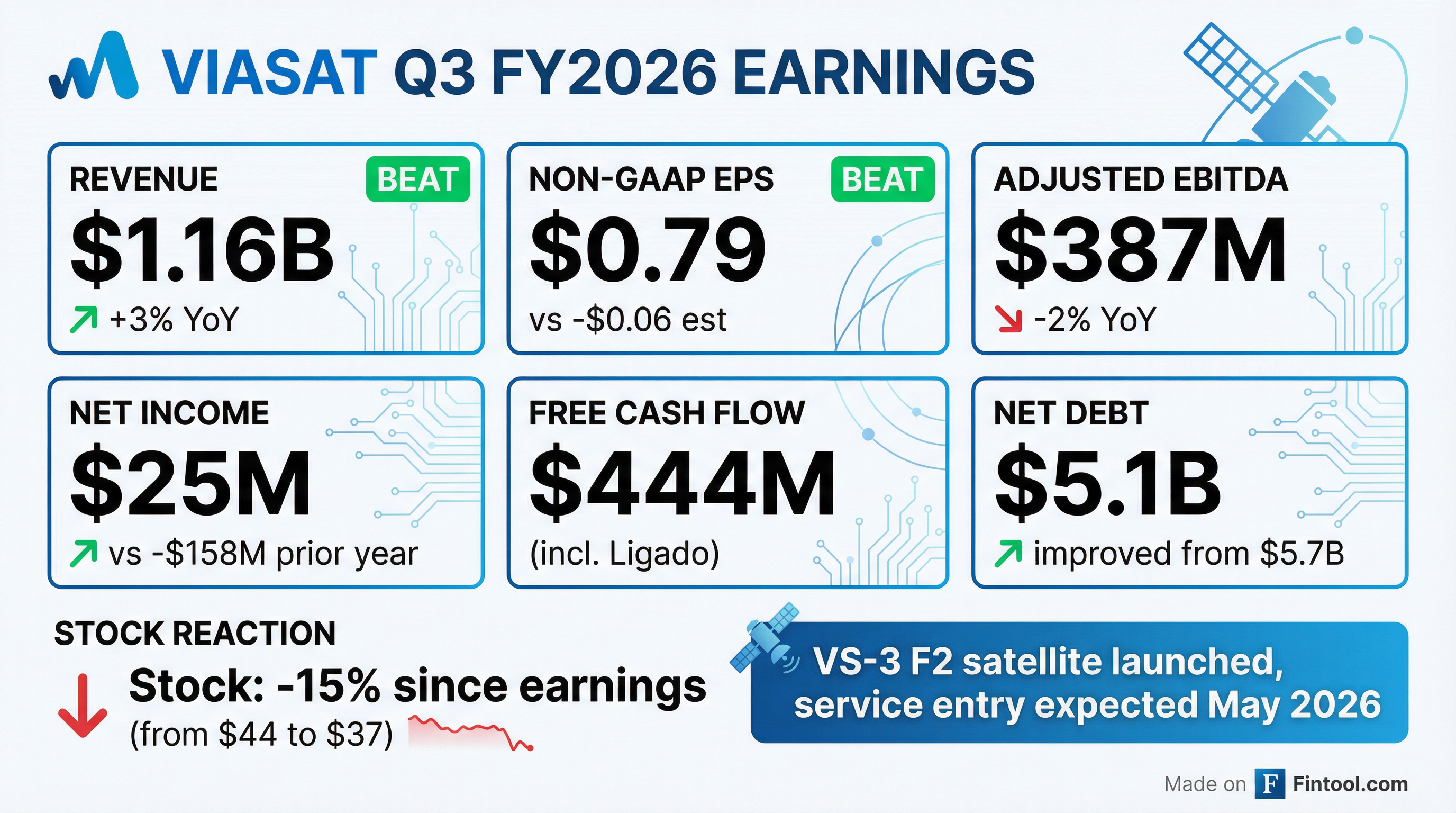
Viasat (NASDAQ: VSAT) reported Q3 FY2026 results that beat on both revenue and EPS, yet shares tumbled 15% from pre-earnings levels. Revenue of $1.157 billion came in 0.7% above the $1.150 billion consensus, while Non-GAAP EPS of $0.79 crushed expectations of -$0.06 . The EPS beat was largely driven by interest income recognized on deferred Ligado settlement payments .
The quarter marked a pivotal operational milestone: VS-3 F2, the company's next-generation satellite, launched in early November and is on track to enter service by May 2026 . Each VS-3 satellite is expected to support more bandwidth capacity than Viasat's entire existing fleet .
Did Viasat Beat Earnings?
Yes, Viasat beat on both revenue and EPS for Q3 FY2026:
Values retrieved from S&P Global and company filings
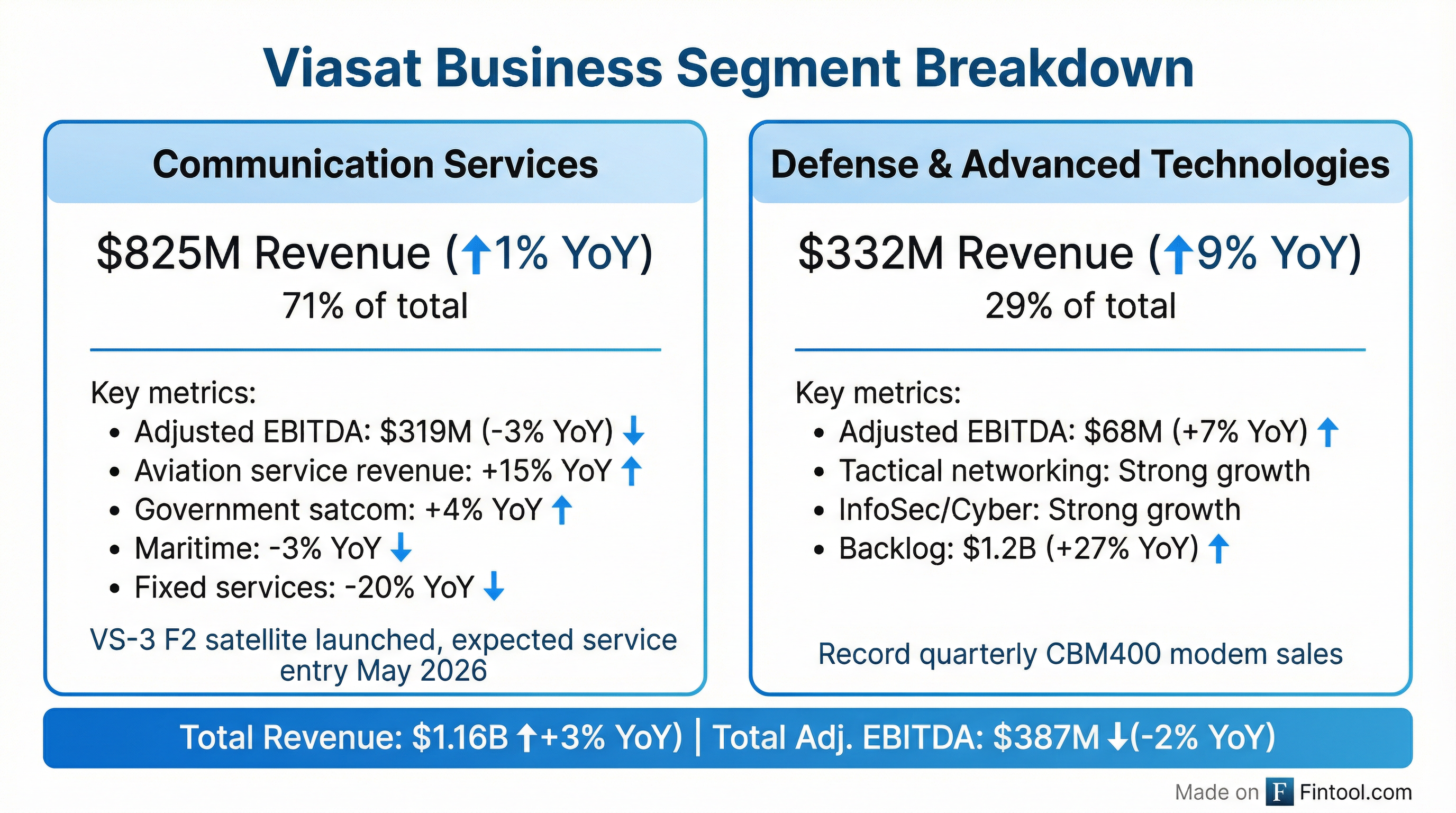
Revenue grew 3% year-over-year, driven by 9% growth in the Defense and Advanced Technologies segment and 1% growth in Communication Services . Net income flipped to positive $25 million from a loss of $158 million in the prior year quarter, primarily due to higher interest income from the Ligado settlement .
 Ask Fintool AI Agent
What Changed From Last Quarter?
Several key developments differentiated Q3 FY2026:
Positive Shifts:
- Net income turned positive — $25M profit vs. -$61M loss in Q2 FY2026, the first quarterly profit in over a year
- Free cash flow surged — $444M including $420M Ligado lump sum payment
- Net debt declined — Fell to $5.1B from $5.5B sequentially after early retirement of $300M Inmarsat term loan
- DAT segment momentum — Revenue grew 9% YoY with record CBM400 modem sales
Areas of Concern:
- Adjusted EBITDA declined — Down 2% YoY to $387M, with Communication Services segment EBITDA falling 3%
- Maritime erosion continues — Service revenues down 3% YoY, vessels declined to ~13,400 from ~14,300 a year ago
- Fixed broadband shrinking — FS&O revenues down 20% YoY, subscribers at ~143,000
- Awards declined — Q3 awards of $971M fell 10% YoY
How Did the Stock React?
Despite the earnings beat, VSAT shares dropped sharply:
The sell-off likely reflects concerns that the beat was driven by one-time Ligado interest income rather than core operating performance. Adjusted EBITDA declined YoY despite revenue growth, and the Communication Services segment—representing 71% of revenue—showed continued pressure in legacy fixed broadband and maritime businesses .
What Did Management Guide?
Viasat maintained most FY2026 guidance while upgrading free cash flow expectations:
Segment-specific outlook:
- Communication Services: Flat revenue YoY, with low double-digit aviation growth offset by lower FS&O declines
- Defense & Advanced Technologies: Mid-teens revenue growth, driven by double-digit growth in InfoSec/cyber defense and space & mission systems
Ask Fintool AI AgentVS-3 Satellite Progress: The Key Catalyst
The VS-3 program represents Viasat's primary growth catalyst. Key updates from the quarter:
Each VS-3 satellite is expected to support more bandwidth capacity than Viasat's entire existing fleet and introduces new resilience capabilities for government and commercial mobility customers . The company highlighted that VS-3 F2 will "unlock a substantial increase in global capacity" and fuel growth in aviation, maritime, and government satcom businesses .
Commercial wins tied to VS-3 capacity:
- Etihad Airways expanded partnership for Viasat Amara multi-orbit connectivity across entire fleet
- American Airlines, Southwest, and KLM deploying full, fast, free in-flight WiFi
- Evergreen Marine (Taiwan's largest container line) rolling out NexusWave fleetwide
Key Management Quotes
On strategic priorities:
"We have three key focus areas to drive revenue growth in FY2027 and beyond: (1) VS-3, (2) multi-orbit, and (3) what some refer to as new frontier defense tech."
— Mark Dankberg, CEO
On the strategic review:
"Our Board's Strategic Review Committee, with the help of independent financial advisers, is guiding our capital allocation and portfolio priorities. We continue to evaluate a range of strategic options, up to and including separating our government and commercial businesses."
— Mark Dankberg, CEO
On financial trajectory:
"Our financial results are evidence of our ability to execute with cash flow and net leverage improvements as key proof points."
— Mark Dankberg, CEO
Defense & Advanced Technologies: The Bright Spot
The DAT segment delivered another strong quarter:
Key contract wins:
- Included in MDA's $150B SHIELD IDIQ for missile defense technology
- Completed Protected Tactical Satellite-Global (PTS-G) System Design Review for US Space Force
- Accelerated MOJO Tactical Gateway awards for US Marine Corps
- 5-year contract extension with Navy Exchange Service Command
Balance Sheet and Cash Flow
Excluding $420M Ligado lump sum payment
*Including $420M Ligado lump sum payment
The company retired the remaining $300M of the original Inmarsat term loan using Ligado proceeds, eliminating a 2026 maturity . Available liquidity of $2.5B includes $1.35B cash and $1.14B undrawn revolving credit facilities .
Ask Fintool AI AgentWhat's Next: Forward Catalysts
Q&A Highlights
On Flight 2/3 Timing (Ric Prentiss, Raymond James):
- Flight 2 is approximately 34 days from reaching station, with final deployments commencing quickly after
- Flight 3 will have a ~2 month orbit raise vs. ~100 days for Flight 2 due to the Falcon Heavy launch vehicle
- CEO confirmed the strategic review is tied to these milestones: "You've got the factors right" — they want F2/F3 in service, macro conditions favorable, and delevering achieved before making decisions
On Space Data Centers (Ric Prentiss):
"The entire premise really hinges on power generation in space... will it ever make sense that you can generate power more cost-effectively in space than anywhere on Earth? So I think that's an open question." — Mark Dankberg, CEO
Viasat has no plans to be in the data center business directly but is "certainly interested in partnering with others" on the communications side .
On Fastest-Growing Market Segments (Ric Prentiss): Management identified two key technical domains with the most growth potential :
- Ka-band broadband — Mobile platforms (aviation, maritime, autonomous vehicles), especially government applications and sovereign ownership models
- L-band / Mid-band D2D — Lower speeds but omnidirectional antennas for cell phones, IoT, watches; billions of devices becoming satellite-capable via 3GPP NTN standards
On D2D and Spectrum Strategy (Sebastiano Petti, JP Morgan):
- Multiple D2D operators will exist due to sovereign/national security requirements — countries want control over satellite communications that bypass terrestrial infrastructure
- Viasat is designing its network to meet 3GPP standards while avoiding interference with neighboring spectrum users
- On Equatys: ongoing negotiations, but entirely consistent with financial objectives of increasing cash flow, reducing debt, and investing wisely
On Telesat Partnership for IFC (Ryan Koontz, Needham):
"With our new aero services, we'll have a new single antenna that can operate both at LEO and GEO simultaneously... We route primarily the latency-sensitive traffic over LEO. The vast majority of the traffic tends to be video, which is not latency sensitive at all, very well suited for GEO." — Mark Dankberg, CEO
Telesat expects to begin launching LEO satellites by end of next year, enabling multi-orbit aero service .
On Quantum-Resistant Cryptography (Mike Crawford, B. Riley): CEO said Viasat's competitive position is "probably improved a little because of the urgency of the problem, and the market size has improved a lot because of the urgency of the problem." They're bullish on the InfoSec growth opportunity .
On Micro-Geosatellites Strategy (Edison Yu, Deutsche Bank):
"We're gonna want follow-ons that cost a small fraction of what the current ones do, but have even better unit productivity... much, much smaller satellites that are much less expensive, with comparable capacity, that we can put wherever the hotspots are." — Mark Dankberg, CEO
This is central to Viasat's strategy to reduce capital intensity and improve ROIC .
On Government Equity Investments (Justin Lang, Morgan Stanley): When asked about structures like L3Harris's planned IPO with government equity stakes, CEO noted: "If those are available and improve competitive position and shareholder value, that's an interesting thing to look at... internationally there may be more instances of that" .
On CapEx Guidance Reduction (Justin Lang): CFO Gary Chase confirmed the revised CapEx guidance is primarily efficiency-driven, not timing-related, except for ~$40M of VS-3 spend shifting into FY2027 .
Ask Fintool AI AgentAdditional Operational Details
Aviation:
- Commercial aircraft installation backlog is now ~1,100 additional aircraft under existing customer agreements
- Some aircraft previously expected to be installed were on legacy Inmarsat platforms and are no longer in the pipeline
- "Hundreds of incremental aircraft" are working through the contracting process
Maritime:
- Nexus Wave cumulative orders exceed 2,600 vessels, with approximately 65% yet to be installed
- Installations up 33% sequentially; company taking actions to accelerate install rates
Fixed Broadband:
- 143,000 subscribers at $112 average revenue per user
- Bandwidth constraints in the U.S. have been a headwind for several years; VS-3 F2 expected to improve offerings and increase gross additions
CapEx Breakdown (FY2026 Guidance of $1.0-1.1B):
Bottom Line
Viasat delivered a beat quarter powered by Ligado settlement income, but the core operating story remains mixed. The Defense segment is thriving (+9% revenue, 27% backlog growth), while Communication Services faces structural headwinds in legacy fixed broadband and maritime. The near-term investment thesis hinges on VS-3 F2/F3 service entry unlocking aviation and maritime growth, but investors appear skeptical given the 15% post-earnings decline. The ongoing strategic review could provide a re-rating catalyst if the company separates its higher-growth defense business from the capital-intensive commercial satcom operations.
Key takeaways from the earnings call Q&A: management is waiting for F2/F3 to enter service before making strategic decisions, sees significant opportunity in D2D/NTN markets through the Equatys partnership, and is focused on developing smaller, cheaper satellites to improve capital efficiency and ROIC .
Analysis based on Viasat Q3 FY2026 8-K filing, shareholder letter, and earnings call transcript published February 5, 2026.